Google just made a big change to its search. Search now uses a new and smarter AI/KI model. Here we explain in Gasta Briefly explain what is new, and what you as a business should do.

Kviknes hotel, Balestrand - one of many tourism companies that must adapt their websites to AI and now also Google search (photo: Kviknes hotel/Bark photo)
What happened?
Google announced on November 12 that Google Search now uses Gemini 4 Hydrogen , the name of the newest version.
Google calls this the biggest upgrade to Search ever. We at Gasta have been working with search engine optimization since 1997, and we have to agree.
Take a test - and you'll understand what we mean. But read the article first😊
What has changed in Google search?
Google understands longer questions. Now you can “google” the way you speak. Google also handles typos and very specific requests.
Questions with multiple parts get answers for each part. Previously, we wrote many short search terms like "hotel Vestlandet". Now you can write:
“We are a married couple in our 60s who would like to spend a romantic weekend at a hotel in Western Norway in May 2027. We would like to experience some culture or go on a mountain hike. Please suggest activities if it rains. What do you recommend? ”
Google then tries to answer everything.
And the answers will be more visual. There will be more photos, tables and comparisons. The answers should be easy to skim.
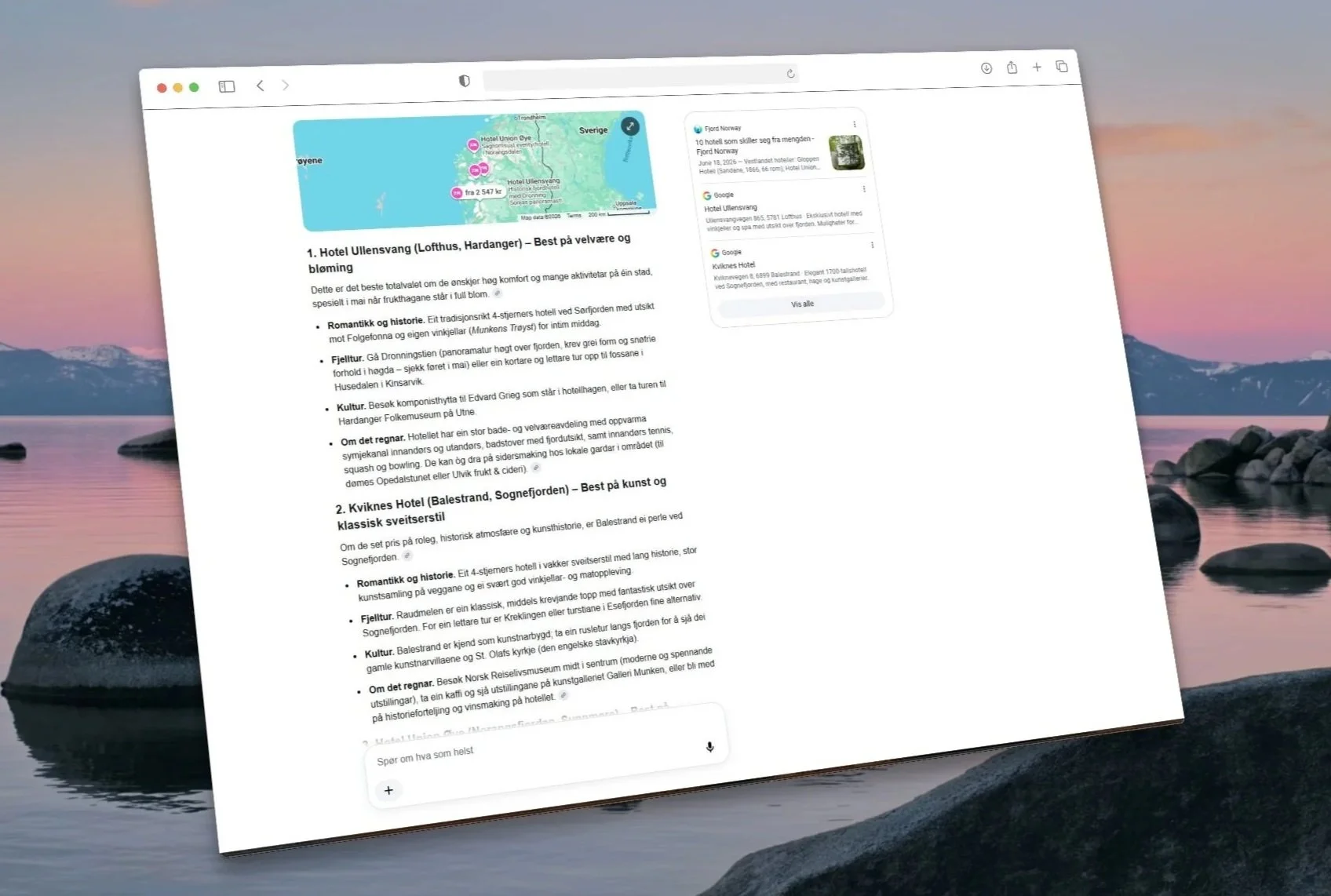
Google searches with questions in multiple parts get answers to each part.
What does this mean for your website?
When you ask a question, Google does many small searches in the background. Each search addresses a part of the question. In the end, Google puts together a single answer. The result is links to more different websites than before .
This is good news for smaller businesses. You don't have to be the biggest to be featured. You have to be the one who best answers a specific question. And the information on the websites must be 100% up-to-date, and for the tourism industry it is important that all the players around you also have updated websites.
You can do this now.
Answer the questions your customers actually ask. Think about what people ask you on the phone and by email. Write the answers on your website. As a Squarespace user, you can log in and click on SEO/AI Visibility. There you can post questions and check how you rank in ChatGPT and Gemini.
Be specific. Write down what you offer, who it's suitable for, where you're based, and how much it costs.
Use lists and tables where appropriate. This makes the content easy to read for both people and Google.
Use good photos with good alt texts. Give photos a short text that explains what they show (alt text).
Keep the information up to date. Opening hours, prices and contact information must be correct. Important!
Write for humans. A clear and honest text works best – also for AI.
Do you need help?
We in Gasta helps you become visible in both regular and AI searches. We look at your website and give you specific advice. Get in touch and we'll have a chat.